When attempting to allocate fair values to assets upon acquisition of an enterprise, there is always a challenge when dealing with residual amounts to intangible assets, especially in distinguishing between those with finite lives as opposed to infinite ones. One argument I have encountered in several circumstances is how much of a valuation one can attach to an enterprise's workforce in contributing to enterprise value. Most of those instances have tended to be based on false assumptions, as a workforce can fundamentally change after a takeover, whether through turnover, planned reductions by the acquirer, or just overly optimistic estimations of the workforce's capabilities.
As far as financial reporting is concerned, IFRS has mostly ruled out such allocations to intangible assets of finite lives. IFRS 3 explicitly states that it is not an identifiable asset (at par. B37). In addition, IAS 38 points out that there is insufficient control over the economic benefits that may result from the assembled workforce (at par. 15). However, there are several identifiable assets that can arise in that area, such as non-competition agreements or employment contracts that are determined to be below-market from the employer's perspective. These, and especially the latter, would be quite sensitive information, in which the detail would be best kept locked away in the acquirer's files!
A valuation may still be relevant in determining allocations to intangible assets that are allowed to be recognized, such as a relationship with a key customer. In such an instance, it is seen as a contributory asset, a relevant part of which is there to sustain the relationship. The best method for determining its value is seen to be that of "reproduction cost" (as opposed to "replacement cost"), which would include the cost of recruiting, training and allowing for attaining maximum effectiveness after going through the appropriate learning curves. This is a component of what is known as the "multi-period excess earnings method," which is a fallback calculation when a more direct estimation of economic benefits is not possible. This is quite an arcane area which has still not been fully discussed in the professional literature, and I have never seen it being properly calculated in practice by others.
That is a summary explanation of the quantitative considerations involved in this matter. There is also the qualitative side, which is often given short shrift in M&A discussions. However, many acquisitions have failed spectacularly, because the acquirer failed to take note of what was happening under the surface at its target.
The corporate cultures of both parties, and potential clashes, is a particularly well-known area for potential downfalls. A target's corporate history, however, may be of more relevant interest. For example, the skills needed to handle startups are not necessary appropriate when the enterprise becomes more mature, and an owner-entrepreneur's behaviour is quite different from that of a professional manager. As well, personal relationships—on many levels, both inside and outside the enterprise—may influence future outcomes, both before and after an acquisition takes place, and those tend to be insufficiently documented. It may well be in an acquirer's best interest to buy some drinks at the bar for some of the key parties (not necessarily at the top levels) or third parties and have a wide-ranging chat with them, before any approaches are being considered. That would be money well spent, before intentions are actually expressed, non-disclosure agreements are signed, and people start feeling committed toward achieving an outcome that would not eventually be beneficial to the acquirer. Of course, there are some crucial legal aspects that are also involved in this entire process, so it might be a good idea to discuss your proposed tactics with a lawyer with great M&A experience before going ahead.
11 January 2016
10 December 2015
Current considerations for appraising capital expenditures
As I was alluding to yesterday, the appraisal of capital expenditures has become much more complex since CMA Canada last explored the topic in 1981. Here are some aspects to consider:
Updates: Typo corrected; "process improvement" and "investment properties" added in investment categories; give examples of non-relevant financing issues.
- The greater participation of the public sector has called for different types of focus. While the cost of capital will tend towards the risk-free rate, there are also greater requirements for considering optimism bias and sensitivity analysis in different components of proposals, the allocation of risks that arise in public-private partnerships, and consideration of relevant benefits to society (including discussion of what is not relevant).
- In the private sector, more rigorous pre-acquisition analysis is required to determine which components are capital and which are expense, for both financial reporting and tax purposes. This is effectively a 2x2 grid, and there is very little summary literature on the topic.
- In the private sector, the after-tax cost of capital will need to be risk-adjusted depending on the nature of the investment. While this is largely a matter of judgment, some rules of thumb for annual rates that have arisen over time are 40% for venture capital and 50% for angel investments. Aside from those, there is the risk of being overly conservative in the assessment of relatively straightforward proposals, as well as from conflating financing issues (government grants, refundable tax credits, and pre-approved financing) with operations issues.
- The tax shield arising from the availability of capital cost allowance is well-settled doctrine, whether through the full-year, half-year or other available methods of calculation. Very little work has been done in assessing the calculations under the US MACRS régime, for those Canadian companies that are fully integrated into US operations for tax purposes, but that could be relevant in certain circumstances.
- Equivalent annual cost calculation is a powerful assessment technique that is still little discussed or applied.
- Very little discussion has been given to the different types of capital investment that are undertaken. Som principal categories I have been familiar with include new business, expansion, process improvement, replacement, investment properties, regulatory compliance, and general corporate requirements (eg, head offices, branding, and company-wide IT or communications structures). In any case, different techniques are available for different purposes, and their application should be given detailed discussion.
- Financial reporting under IFRS (but even before that, under the old CICA Handbook) calls for assessment of fair value and impairment of assets under specified conditions. These are important limits that must be considered in any risk analysis for acquisitions.
Updates: Typo corrected; "process improvement" and "investment properties" added in investment categories; give examples of non-relevant financing issues.
09 December 2015
A Body of Knowledge passé?
Several decades back, CMA Canada was doing extensive work in analyzing and compiling best practices for management accounting, and established the CMA Canada Research Foundation to focus on that work. In addition to commissioning various studies, it also issued the Management Accountants Handbook and Management Accounting Practices Handbook for CMAs to abide by. They're quite prominent in my library.
I was recently wondering what is happening to that focus, now that all CMAs, CAs and CGAs are now part of CPA Canada. It turns out that notice was given in 2013 that the Foundation intended to surrender its charter. That has not happened yet, but it appears that it will lapse because of non-continuance under the Canada Not-for-Profit Corporations Act.
That's not all. The Handbooks themselves have never been updated since 1998, although electronic copies of the contents were always available from the CMA Canada website. That site is no longer available, and the new CPA Canada Store does not have access to them.
That's a pity. There was a lot of great advice that came out of this work, and much of the research was seminal in developing management accounting as we know it today. One study in particular, A Practical Approach to the Appraisal of Capital Expenditures, deserves to be updated to cover today's broader range of issues.
I hope CPA Canada revives access to this work. Otherwise, it would appear that our amalgamation was in reality a takeover.
06 November 2015
Better analysis using Gnuplot
My recent posting using images generated from Gnuplot was rather basic. After examining its quite voluminous documentation somewhat cursorily, I have been able to significantly improve the output.
For example, the impact of tax rates and cost of capital on investment in Class 29 assets is illuminated through the use of colour:
 Adding a 2D heatmap with the original 3D chart really does clarify the nature of the impact. By specifying different colours to different ranges of after-tax cost, we can more easily gauge the effects.
Here it is for Class 53:
 You can easily see that the colours are shifting to the left, thus showing that the net after-tax cost is generally becoming cheaper.
And for Class 43:

You can note the impact quite distinctly between the three graphs.I have only just begun to explore this particular application, but I am already impressed with its power.
For example, the impact of tax rates and cost of capital on investment in Class 29 assets is illuminated through the use of colour:

Here it is for Class 53:

And for Class 43:

You can note the impact quite distinctly between the three graphs.I have only just begun to explore this particular application, but I am already impressed with its power.
05 November 2015
A follow-up on the impact of the federal budget
Last spring, I published a post on the impact of changes in capital cost allowance rates on the after-tax cost of investment. I attempted to quantify the impact, but I have wondered since about what would happen if the variables relating to tax rates and cost of capital changed, and how to express that clearly.
I have recently come across gnuplot, an open-source program that helps to chart questions like this, and inputted the data. I decided to plot all possible combinations from 1% to 99% for both cost of capital and composite corporate tax rates.
For the current Class 29 framework, the chart looks like this:
 There are two things that immediately stand out:
 Note that this reduces the net after-tax cost attributable to higher costs of capital. This is especially important when such costs are weighted for risk.
And what about Class 43, which is supposed to return in 2025? While very theoretical, because of the recent change in government in Ottawa, here is what it would look like:
 You can see immediately that the cost of capital aberration returns.For that reason alone, I would venture to guess that that option will never return to the Canadian tax structure.
All of these charts do highlight a major flaw in the current system, which all political parties in Canada have failed to see: as lower tax rates make the net after-tax cost of investment much more expensive, that means that current rate reductions given to manufacturing and small business are actually making it more expensive for them to invest in more productive assets. The UK, probably for that very reason, decided recently to abolish its preferential small business rate, and have opted to bring in concepts such as the "patent box" to assign lower tax rates based on the results of specified investments.
That may well be worth implementing here.
I have recently come across gnuplot, an open-source program that helps to chart questions like this, and inputted the data. I decided to plot all possible combinations from 1% to 99% for both cost of capital and composite corporate tax rates.
For the current Class 29 framework, the chart looks like this:

- as the tax rate rises, the net after-tax cost falls; and
- as the cost of capital rises, the net after-tax cost increases as well.

And what about Class 43, which is supposed to return in 2025? While very theoretical, because of the recent change in government in Ottawa, here is what it would look like:
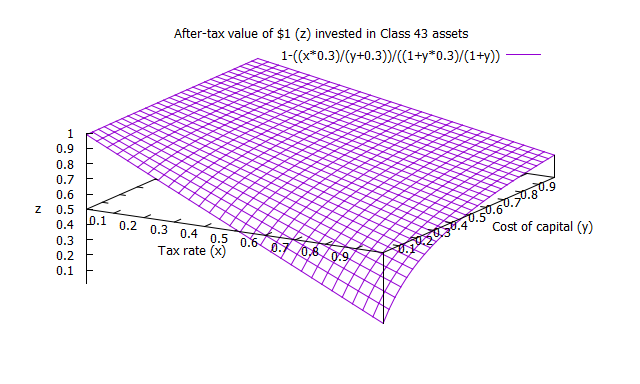
All of these charts do highlight a major flaw in the current system, which all political parties in Canada have failed to see: as lower tax rates make the net after-tax cost of investment much more expensive, that means that current rate reductions given to manufacturing and small business are actually making it more expensive for them to invest in more productive assets. The UK, probably for that very reason, decided recently to abolish its preferential small business rate, and have opted to bring in concepts such as the "patent box" to assign lower tax rates based on the results of specified investments.
That may well be worth implementing here.
14 October 2015
"The motherboard is fried."
I had some downtime this past week, when the HP laptop suddenly failed to boot. This was unexpected, and I had to take it in for the first time to have it looked at. The above headline summarizes the result. Thankfully, I was able to get my files retrieved, and they now lie on a nice little(!) 32Gb USB drive.
It had served me well for almost five years, and it was just upgraded to Windows 10 last month. That was a smooth process, although it took almost two hours to perform. Thankfully, I'm rather patient.
After investigation, I settled on a Lenovo Windows 7 Pro laptop with Intel i5. I normally prefer AMD chips, but I've learnt that they run hotter and are probably better suited for desktop workstations. That's interesting information to keep in mind for the future.
Within 24 hours, I now have it running on Windows 10, as I was informed that the laptop qualified for immediate upgrade. All other applications I required, in their latest versions, have also been downloaded and installed. They are all legal as well: I am a fan of open source apps, and they operate very well these days! Together with a second monitor, I'm now back in business.
28 September 2015
Corporate stupidity: It's only gotten bigger
The recent news about how Volkswagen gamed their vehicles' software for the diesel emissions tests has been distressing, even causing some serious discussion about whether the diesel engine market itself will survive. The fact that these engineers could devise such software was perversely brilliant, but such abilities could have been better used to work on solutions that could reduce NOx emissions, which was supposed to be the point.
I wish I could say that this type of behaviour is unusual, but it has always existed at one scale or another. Here are some interesting stories I've been told over the years.
Leaving aside bankers' predictable habits of lending against the security of assets that are ready to tank (as when a real estate bubble is ready to burst), there are other instances that can really make you shake your head. Take in the mid-60s, when the Toronto-Dominion Centre was being constructed.

One contractor was given the job of finishing TD's executive offices, where the architect specified mirrored surfaces with bronze glass, which would coordinate with the outer skin of the buildings. To their dismay, the mastic used to bind the glass to the underlying substrate was tainted, which caused the mirrors' silvering to blotch and develop black spots quite badly throughout the office layout. As the mastic had set, nothing short of dynamite could have removed it, so any resulting warranty repairs had the potential to render the contractor insolvent.
They were ready to face the music when TD's Chairman came to inspect how things were coming along. To their surprise, he exclaimed, "I don't like it! It's too dark in here. I want it all replaced with something lighter, and I don't care how much it costs!"
It was replaced, and, as extras in a contract always fetch higher margins, that year turned out to be that contractor's most profitable in years. They were still laughing about how that turned out twenty years later, when I first heard the story.
Something a little more in keeping with my line of work always has the capacity to surprise. For instance, auditors' standard practice has always included preparing a management letter at the end of an annual audit which gives points that they hope will be useful for the client. When a former boss of mine (who, alas, is now deceased) was still a hard-working CA for one of KPMG's predecessors, he was involved in an audit for Cochrane-Dunlop, which used to be one of the larger hardware distributors in Canada.
At the end of that particular year's audit, they had assembled quite a list of suggestions to help the company operate in a more tax-efficient manner. However, when they made their presentation, they could not help but notice that the Chairman's face was getting redder as time went on. He suddenly started shouting: "I completely object to what you are saying! I love this country, and I consider it my duty to pay as much tax as I possibly can to support it!" The audit team promptly hushed up, and the meeting wound up faster than they had planned.
Some subsequent history to note: Cochrane-Dunlop went bankrupt in 1987. Its industrial products division was sold to C.N. Weber (now known as Weber Supply), and the consumer products division (which had serviced Dominion Hardware, now part of PRO Hardware) was shut down. It makes you wonder what else there may have been that caused their priorities to be so fundamentally off base.
I wish I could say that this type of behaviour is unusual, but it has always existed at one scale or another. Here are some interesting stories I've been told over the years.
Bankers and their ability to handle money
Leaving aside bankers' predictable habits of lending against the security of assets that are ready to tank (as when a real estate bubble is ready to burst), there are other instances that can really make you shake your head. Take in the mid-60s, when the Toronto-Dominion Centre was being constructed.

One contractor was given the job of finishing TD's executive offices, where the architect specified mirrored surfaces with bronze glass, which would coordinate with the outer skin of the buildings. To their dismay, the mastic used to bind the glass to the underlying substrate was tainted, which caused the mirrors' silvering to blotch and develop black spots quite badly throughout the office layout. As the mastic had set, nothing short of dynamite could have removed it, so any resulting warranty repairs had the potential to render the contractor insolvent.
They were ready to face the music when TD's Chairman came to inspect how things were coming along. To their surprise, he exclaimed, "I don't like it! It's too dark in here. I want it all replaced with something lighter, and I don't care how much it costs!"
It was replaced, and, as extras in a contract always fetch higher margins, that year turned out to be that contractor's most profitable in years. They were still laughing about how that turned out twenty years later, when I first heard the story.
Misguided priorities of management
Something a little more in keeping with my line of work always has the capacity to surprise. For instance, auditors' standard practice has always included preparing a management letter at the end of an annual audit which gives points that they hope will be useful for the client. When a former boss of mine (who, alas, is now deceased) was still a hard-working CA for one of KPMG's predecessors, he was involved in an audit for Cochrane-Dunlop, which used to be one of the larger hardware distributors in Canada.
At the end of that particular year's audit, they had assembled quite a list of suggestions to help the company operate in a more tax-efficient manner. However, when they made their presentation, they could not help but notice that the Chairman's face was getting redder as time went on. He suddenly started shouting: "I completely object to what you are saying! I love this country, and I consider it my duty to pay as much tax as I possibly can to support it!" The audit team promptly hushed up, and the meeting wound up faster than they had planned.
Some subsequent history to note: Cochrane-Dunlop went bankrupt in 1987. Its industrial products division was sold to C.N. Weber (now known as Weber Supply), and the consumer products division (which had serviced Dominion Hardware, now part of PRO Hardware) was shut down. It makes you wonder what else there may have been that caused their priorities to be so fundamentally off base.
Subscribe to:
Posts (Atom)
Why don't Canadian businesses invest?
The tendency of Canadian businesses to under-invest has been noted for decades, and the Fraser Institute reported in 2017 that investment f...

-
April was a good month for the accounting profession here in Ontario, from my point of view. Us CMAs became entitled to be called Chartered ...
-
I've been digging into some personal history lately, after having heard that several people I knew back in the early 1980s have recently...
-
 Last spring, I published a post on the impact of changes in capital cost allowance rates on the after-tax cost of investment. I attempted ...